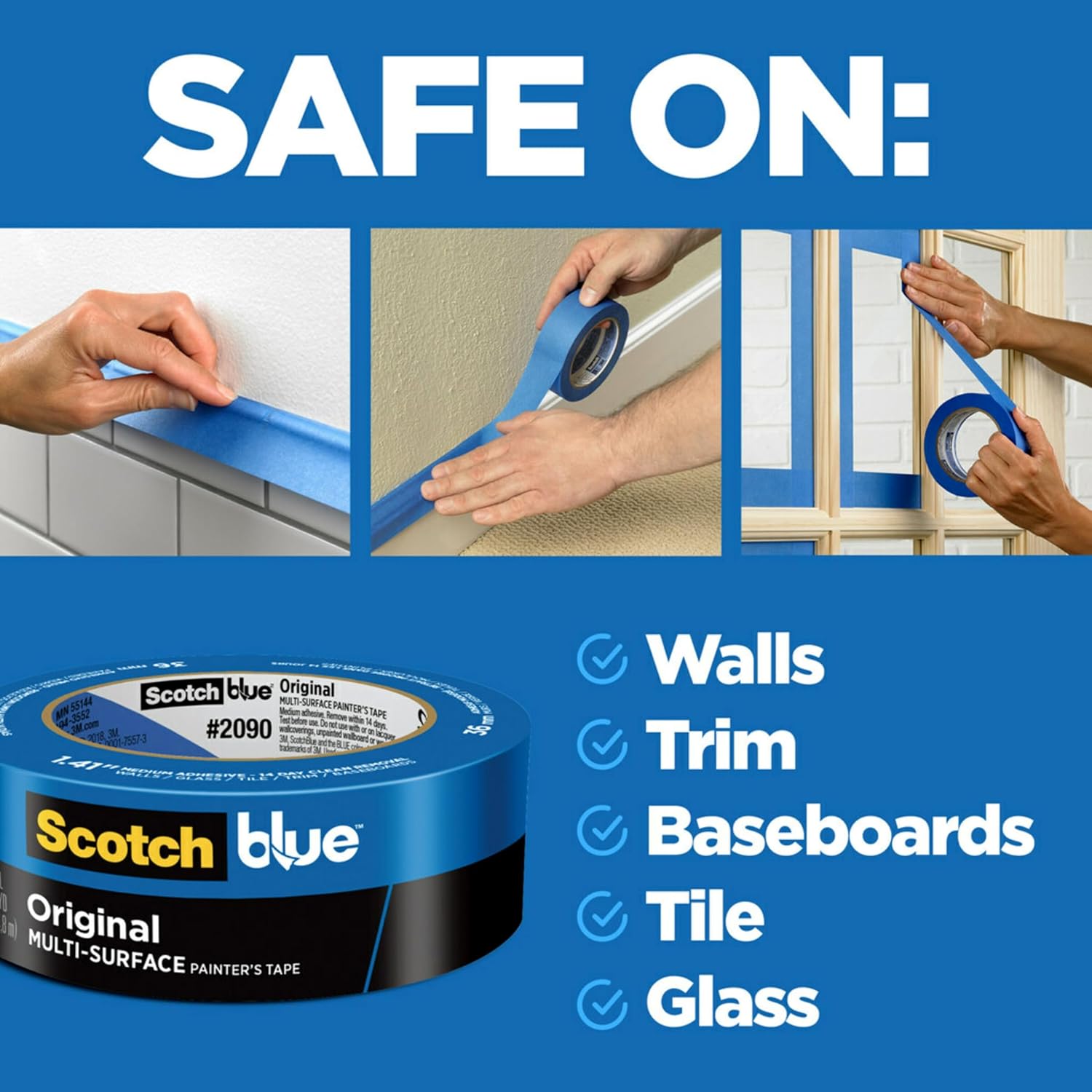
You’re standing in the paint aisle at Home Depot, cart already loaded with two gallons of Sherwin-Williams Emerald, and you’re holding a single roll of ScotchBlue 2090 wondering if one is enough. Painters tape — the low-tack, easily removable masking tape (meaning it sticks well to surfaces but peels off cleanly without damage or paint bleed) that creates crisp lines between wall colors, trim, and ceilings — seems like a boring afterthought. It isn’t. Running out mid-wall forces you to stop, drive back to the store, and restart a wet edge that’s already begun to set. Buying too much at full retail price leaves you with a drawer full of rolls that dry out within 6–12 months. This guide gives you a repeatable calculation method, a breakdown of when to buy cheap versus premium tape, and a frank look at which bulk formats actually save money on projects spanning three rooms or more.
The Core Calculation: Linear Feet, Room by Room
The fundamental unit you’re working with is linear feet of tape — the total length of every edge, seam, and transition you plan to mask. Painters tape isn’t sold by the square foot of wall; it’s sold by roll length, typically 60 yards (180 feet) per standard roll for the 1-inch width, though widths from ¾-inch to 3-inch and roll lengths from 60 to 180 yards exist across the product lines at 3M and Shurtape.
Here’s the room-by-room math:
For a standard bedroom, living room, or dining room — roughly 12×14 feet with 9-foot ceilings — the perimeter runs about 52 linear feet. You’re taping four zones:
- Ceiling-to-wall line (top of walls, every wall): ≈ 52 feet
- Baseboard/floor transition (bottom of walls, every wall): ≈ 52 feet
- Window and door casings (trim around each opening): 25–35 feet per opening
- Any accent wall or color break (if painting only one wall): ≈ 14 feet plus height transitions
For a single room with two windows and one door, no accent wall:
- Ceiling line: 52 ft
- Baseboard line: 52 ft
- Window casings (2): 60 ft
- Door casing (1): 30 ft
- Total: ~194 linear feet
One 60-yard roll (180 feet) gets you close but not across the finish line for that room alone. Budget 1.25 to 1.5 rolls per standard room as your baseline, and you’ll build in enough buffer for overlapping corners, do-overs on tricky trim profiles, and the inevitable strip you tear wrong.
The Bulk Multiplier Table
| Room Count | Base Roll Estimate | Buffer Multiplier | Total Rolls to Buy |
|---|---|---|---|
| 2 rooms | 3 rolls | ×1.3 | 4 rolls |
| 4 rooms | 6 rolls | ×1.25 | 8 rolls |
| 6–8 rooms (whole home) | 10–12 rolls | ×1.2 | 12–15 rolls |
| 10+ rooms (contractor run) | 16+ rolls | ×1.15 | 18–20 rolls |
The buffer shrinks as room count grows because your waste-per-room efficiency improves — you get better at tearing to length, and you’re less likely to cut strips too short when you’re not rationing.
When to Buy Cheap, When to Buy Premium
This is the trade-off most intermediate DIYers get wrong. The instinct is to buy the least expensive masking tape in bulk because “it’s just tape.” That logic holds in exactly one scenario: if you’re painting flat latex on freshly primed smooth drywall with no textured surfaces and you’re pulling the tape within two hours of the final coat. In most real-world conditions, the tape grade directly affects your outcome.
The tiers, honestly assessed:
Budget masking tape ($3–$5/roll) — hardware-store house brand or Amazon generic. Per aggregated reviewer reports across home improvement forums and buying guides at The Spruce and Bob Vila, these bleed through on any textured surface and lose adhesion when left overnight. Acceptable for protecting drop cloths or wrapping roller handles. Not for crisp lines.
Mid-tier: ScotchBlue Original 2090 (~$6–$8/roll) — The baseline for most DIY applications. 3M’s own product specification sheets rate it for up to 14 days clean removal on most surfaces. Owners consistently report clean lines on smooth drywall and light woodwork. Where it struggles: rough brick, heavily textured popcorn-adjacent walls, and freshly applied joint compound that hasn’t fully cured. This is the bulk-buy sweet spot for most 4–8 room whole-home repaint projects on standard construction.
Premium tier: FrogTape Multi-Surface (~$9–$12/roll) — Shurtape’s FrogTape product FAQ describes its PaintBlock technology (a surfactant embedded in the tape edge that reacts with latex paint to form a micro-seal) as the primary differentiator. Reviewers at This Old House and across aggregated professional painter reviews consistently rate it the top performer on textured walls and for watercolor-sharp lines on trim. The cost premium is real — figure $2–$4 more per roll — but on a whole-home project where trim quality visibly defines the result, the math works out. Ten rolls at $10 each versus ten rolls at $7 each is a $30 difference on a project already at $1,500+ in paint costs.
Specialty: ScotchBlue 2080 (Delicate Surfaces) and FrogTape Delicate (~$10–$14/roll) — Lower tack formulated for freshly painted walls, wallpaper, and surfaces where standard tape would lift the substrate. If you’re doing a two-stage paint job — painting the walls first, then taping walls to paint trim — this is not optional; it’s the tool for the job.
The decision rule: For smooth drywall on a budget, ScotchBlue 2090 in bulk is the pick. For textured surfaces, trim with deep profiles, or any situation where you’re leaving tape on overnight, FrogTape Multi-Surface justifies the premium and the per-roll price difference is noise relative to your total project spend.
Bulk Formats: Where the Real Savings Are (and Where They Aren’t)
Buying tape in bulk only saves money if you’re buying the right format. Here’s what actually exists in the supply chain as of mid-2026:
Contractor packs (3M, FrogTape): Both brands offer 6-roll and 12-roll contractor packs in the 1.41-inch (standard) and 0.94-inch (trim) widths. The 12-roll contractor packs — available at most big-box stores and through pro-supply accounts — typically land at 15–20% below per-roll retail pricing. On ScotchBlue 2090, that moves the effective per-roll cost from roughly $7.50 to $6.00–$6.25 for a 60-yard roll. Real savings, but modest. The format is genuinely useful: the rolls are all the same batch, so you get consistent adhesion rather than mixing old and new stock.
Pro-supply / distributor accounts: If you’re specifying paint through Sherwin-Williams PRO or a Benjamin Moore trade account, ask about tape through the same account. Distributor pricing on ScotchBlue and comparable masking products can run 25–35% below consumer retail. This is the most underutilized option for designers and renovation contractors running 10+ room projects annually.
Big-box bulk displays vs. online: Home Depot and Lowe’s typically carry contractor 6-packs at prices that are competitive with online bulk pricing once you factor in shipping. Per Bob Vila’s buying guide coverage of painting supplies, the in-store pro desk (not the regular checkout line) sometimes has contractor pricing on tape that doesn’t show on the retail floor. Worth asking explicitly.
The shelf-life caveat: Every manufacturer rates painters tape at 12–18 months from production date before the adhesive begins to degrade — particularly the acrylic adhesive in premium tapes. 3M’s product specification documentation confirms a 12-month recommended shelf life for opened or temperature-stressed rolls. Buying 30 rolls when you need 14 isn’t savings; it’s waste. Size your bulk buy to the project at hand, with a modest reserve (2–4 rolls) for touch-up work.
The Variables That Break the Formula
The linear-foot calculation gets you close, but four factors will push your actual usage higher than the math suggests:
1. Wall texture. Orange-peel or knockdown texture requires you to press tape more carefully and occasionally double-run edges where the tape bridges the texture pattern rather than sealing it. Owners of heavily textured homes consistently report using 20–30% more tape per room than smooth-wall equivalents, partly due to more careful application and partly due to more pull-and-redo when lines don’t seal cleanly.
2. Color contrast. Painting a white room one color — tape, paint, done. Painting a multi-color scheme with three or four color zones means you’re taping, painting Zone A, pulling tape, re-taping for Zone B. Your tape consumption can double or triple in complex color schemes. Budget accordingly.
3. Trim complexity. Standard colonial casing (flat, rectangular profile) takes about 25 feet of tape per door. Elaborate Victorian casing with layered profiles takes significantly more because you’re taping multiple planes. Older homes consistently generate higher tape consumption per opening than new construction.
4. Paint dry time and removal windows. Premium tape’s clean-removal window — 14 days for 2090, similar for FrogTape — doesn’t mean you should use it. Architectural Digest’s painting coverage and aggregated contractor reports both note that removing tape while the paint is still slightly tacky (30–60 minutes after final coat, pulling at 45 degrees back over itself) produces sharper lines than waiting overnight. If your workflow doesn’t allow same-day removal, buy the delicate-surface formulations to avoid substrate damage.
Here’s What to Buy
If you’re painting 2–4 rooms on standard drywall: Buy one 6-pack of ScotchBlue 2090 in the 1.41-inch width. Add one roll of FrogTape Multi-Surface for any textured accent walls. You’ll finish the project without running out and without a drawer full of leftovers.
If you’re running a 6–8 room whole-home repaint: Buy two 6-packs of ScotchBlue 2090 (12 rolls total), add one 4-pack of FrogTape for trim and any complex surfaces. If your walls are heavily textured, flip those ratios — lead with FrogTape Multi-Surface and keep 2090 for baseboards and flat surfaces.
If you’re a designer or contractor specifying for 10+ room projects regularly: Open a pro-supply account and buy through distributor pricing. The 20–30% discount across consistent volume makes the effort worthwhile on tape alone — and you’re likely already buying paint through the same channel.
The tape budget is never the expensive part of a painting project. But running out at 4 PM on a Saturday when you’ve got a wet accent wall and an open paint can is a completely avoidable problem. Do the linear-foot math once, add your buffer, and buy it all before you open the first can.