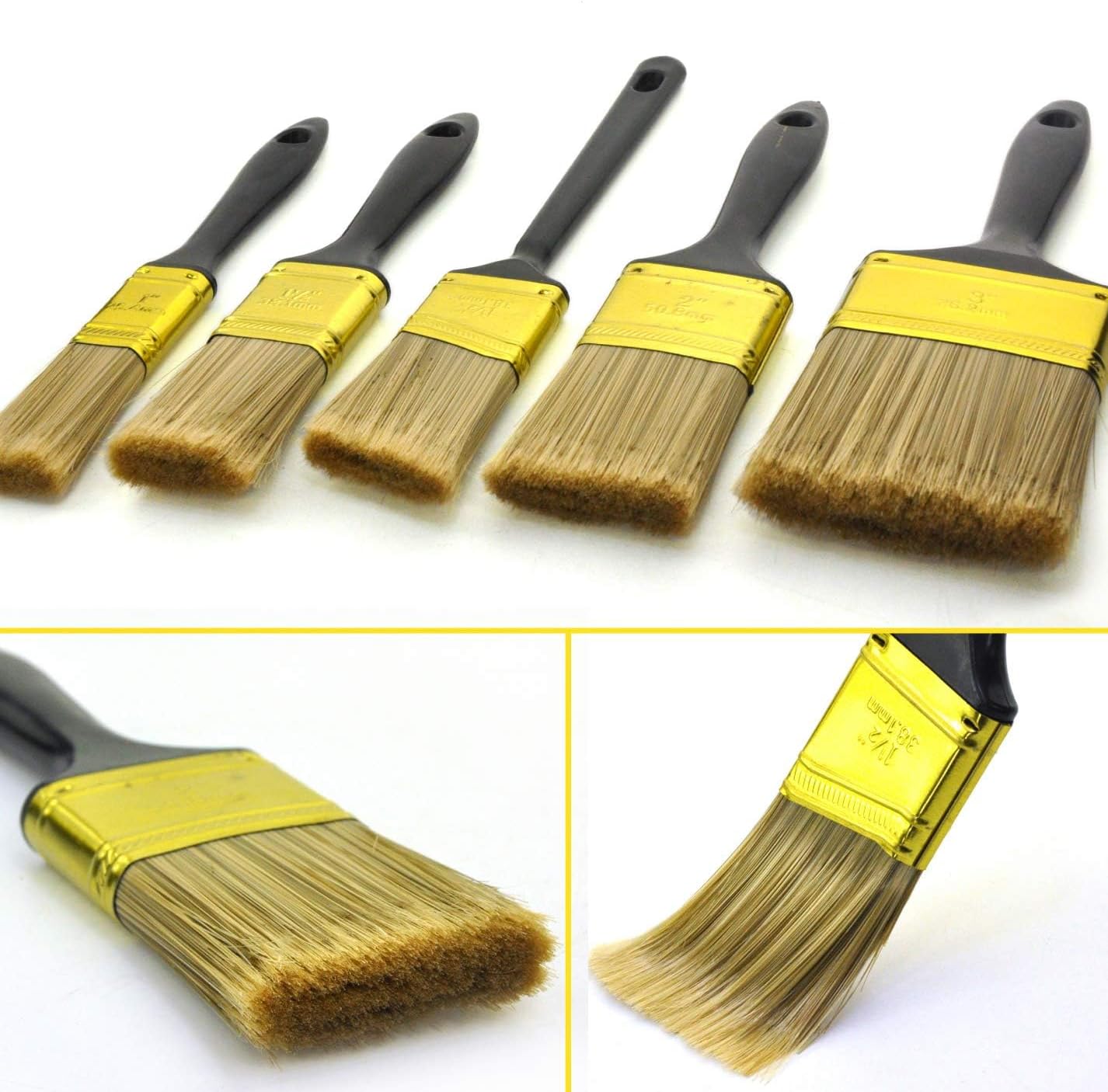
You’re standing in the paint aisle, gallon of Benjamin Moore Regal Select in hand, and you realize you haven’t given a single thought to brushes. There’s a $4 foam brush, a $7 chip brush, and a $34 single Purdy Nylox sitting on the peg. None of them feel right. A paint brush, for anyone new to this: it’s just a handle with bristles — but those bristles are either natural (animal hair, best for oil-based paints) or synthetic (nylon or polyester, best for water-based latex). The shape of the bristle bundle — flat, angled, or round — controls how the paint goes on in tight corners versus broad walls. Get that matchup wrong and you’ll spend twice as long and use twice as much paint. This guide breaks down exactly which brush types earn their place in a whole-room set, where to spend and where to save, and what to buy depending on your specific project scope.
| EDITOR'S PICK[Purdy 140853100 XL Brush 3 Pack](https://www.amazon.com/dp/B00173574I?tag=greenflower20-20) | Mid-tier[King Origin Versatile Paint Bru…](https://www.amazon.com/dp/B0711SM763?tag=greenflower20-20) | Budget pick[Pro Grade Paint Brushes](https://www.amazon.com/dp/B07BVYXL1Y?tag=greenflower20-20) | |
|---|---|---|---|
| Brush count | 3 | 30 | 5 |
| Sizes included | — | 0.5" 1" 1.5" 2" 2.5" | — |
| Brush types | — | — | Flat & Angle |
| Paint types | — | — | Latex & Oil |
| Price | $21.98 | $17.84 | $7.99 |
| See on Amazon → | See on Amazon → | See on Amazon → |
Why a Set Beats Buying Singles (Most of the Time)
The first instinct for an experienced DIYer is to cherry-pick singles: one premium angled sash brush for trim, one wide wall brush for flat surfaces, done. That logic works fine for a single room repaint in a consistent finish. But once a project scales — think whole-home renovation, or a space with high trim volume, textured walls, and detailed millwork — buying singles gets expensive fast, and you end up with redundancy anyway.
A curated multi-brush set solves three problems at once. First, it gives you the right tool for each surface without forcing you to improvise (foam brushes on crown molding, for example, is a pattern that reviewers at This Old House consistently flag as one of the most common application mistakes). Second, sets are almost always priced at a discount to the sum of their parts — the margin difference between a four-brush set and four comparable singles typically runs 20–35%, per pricing tracked across major hardware retailers in spring 2026. Third, sets from a single manufacturer share the same ferrule style (the metal band that holds the bristles to the handle) and handle balance, which matters more than most people expect when you’re switching tools every 20 minutes.
The tradeoff is fit: no set covers every scenario perfectly. You’ll likely supplement with one or two singles. The goal here is to identify the core set that handles 85–90% of your surface area, then fill the gaps precisely.
The Surface Map: What You’re Actually Covering
Before buying anything, sketch a quick surface inventory for the room or project. Every surface type demands a different brush behavior:
Large flat walls — This is where a 3- to 4-inch flat or slightly angled wall brush does most of the work. You want thick, full bristles that hold a large paint load. Synthetic bristles (nylon/polyester blends) work well with modern latex paints — the bristles don’t absorb water from the paint, so they stay stiff longer and release paint more evenly. Owners across aggregated reviews on The Spruce and Bob Vila consistently praise the Wooster Shortcut and Purdy Clearcut for this reason.
Trim, baseboards, and door casings — A 2- or 2.5-inch angled sash brush is the standard here. “Sash” just means the bristle tips are cut at an angle, giving you a sharp leading edge for cutting a clean line between wall and trim without painter’s tape (or at least with less of it). The Wirecutter/New York Times roundup on paintbrushes identifies this brush type as the single highest-value tool in a set — it’s the one that determines whether your finish looks professional.
Window muntins and detailed millwork — A 1- or 1.5-inch angled brush. Nothing else fits without overloading the surrounding surface. If your project has divided-light windows or carved trim profiles, this is where natural-bristle brushes (like those used with oil-based trim paints or alkyd hybrids) can give you more control, because natural fibers hold a finer tip.
Ceilings — Often painted with a roller, but brush-cutting the perimeter is necessary. A 2.5-inch flat or angled brush handles this. Some sets include a dedicated ceiling brush with a longer handle, which reduces neck strain significantly — worth looking for.
Textured surfaces (orange peel, skip trowel, brick) — Brushes don’t love texture; rollers do most of the work here. But a stiff-bristle brush in the 3-inch range can work texture into crevices that a roller misses. If your room has heavy texture, make sure your set includes a thicker-bristle option.
By the Numbers: Brush-to-Surface Matchup
| Surface Type | Ideal Brush Width | Bristle Type | Priority in Set |
|---|---|---|---|
| Large walls | 3–4 inch flat/angled | Synthetic | Secondary (roller does heavy lifting) |
| Trim & baseboards | 2–2.5 inch angled sash | Synthetic or natural | Highest |
| Detailed millwork/windows | 1–1.5 inch angled | Natural or fine synthetic | High |
| Ceiling perimeter | 2.5 inch flat or angled | Synthetic | Medium |
| Textured surfaces | 3 inch stiff synthetic | Synthetic | Situational |
Where to Spend, Where to Save
Here’s the tradeoff that most guides gloss over: brush quality matters enormously on trim and almost not at all on broad interior walls, where a roller is doing the real work and you’re brushing only to cut a line or fill a short section.
Spend on your sash brush. This is the single tool that separates a room that looks painted from one that looks finished. A $20–$30 Purdy or Wooster angled sash brush — both available at most home centers and through major online retailers — holds an edge through a full room, releases paint evenly without dragging, and cleans up without splaying. Owners in long-run reviews consistently report getting 10–15 uses out of a quality brush with proper cleaning, meaning your cost-per-use drops below $2–$3 per room. A cheap $5 brush that splays after two uses is the more expensive option.
Save on your wall brush. A 3-inch utility wall brush from any mid-tier brand handles perimeter cutting on flat latex just fine. You’re not doing detail work; you’re loading paint and moving it. Apartment Therapy’s coverage of DIY painting consistently notes that most homeowners can’t distinguish the mark of a $30 wall brush from a $10 one when the surface is flat latex and the roller is doing the main coverage.
Sets to look at by tier:
Budget-friendly tier ($15–$30 for the set): Wooster and Purdy both offer entry-level multi-brush sets — usually three to five brushes spanning 1-inch to 3-inch widths — that reviewers at Bob Vila and The Spruce rate as legitimate starting points for interior latex work. Bristle quality won’t hold up for years of heavy use, but for a single whole-room project or occasional renovator, these cover the surface map without a meaningless investment.
Mid-tier ($35–$60 for the set): This is where most practitioners with more than one project a year should land. Purdy’s Nylox sets and Wooster’s Silver Tip line use nylon/polyester blends that owners report hold their shape through dozens of uses with proper care. The ferrule-to-bristle bond is tighter, which means less bristle loss mid-stroke — a small thing that becomes very annoying on dark or saturated colors. If you’re applying a premium paint like Sherwin-Williams Emerald or Benjamin Moore Aura, where you’ve already committed $70–$85 per gallon, don’t undermine it with brush-induced stippling.
Premium single supplements ($25–$40 per brush): If your project includes oil-based or alkyd trim paint — still a common spec for high-durability door and window trim — add a natural-bristle brush (ox hair or China bristle) as a single purchase. Natural bristles and oil-based paint are a combination that published specs and professional painter forums consistently identify as delivering a noticeably smoother finish than synthetic alternatives. This is not a set situation; it’s a targeted addition.
Cleaning and Longevity: The Math That Justifies the Spend
A quality brush that gets cleaned immediately after use lasts 10–20 applications. A quality brush that dries with paint in the ferrule is trash. That’s the entire equation.
For latex: rinse under warm water while working the bristles back toward the ferrule, then wash with mild dish soap, reshape, and hang bristle-down or lay flat to dry. Never stand a wet brush on its bristles — it permanently splays the tips.
For oil-based: mineral spirits (paint thinner) first, then dish soap and water. This takes longer and costs a little in solvent, but it’s the only way to maintain natural-bristle performance.
The cost-per-use math on a $25 Purdy Nylox sash brush, cleaned properly, across 15 uses: $1.67 per project. The math on a $6 brush that lasts two uses before the bristles go sideways: $3.00 per project, plus the time lost fighting a bad tool on a job where the trim is already making you anxious.
The Decision Rule
Here’s where this lands:
If you’re doing a single room repaint in latex, budget is the priority, and you own no brushes: Get a mid-range three- or four-brush set in the $20–$35 range from Wooster or Purdy. You’ll have everything you need. Skip the premium singles.
If you’re doing a multi-room or whole-home project with trim in multiple finishes: Invest in a quality mid-tier set ($40–$60) and supplement with one premium 2.5-inch angled sash brush. Clean everything meticulously. Your total outlay is $65–$80 and you’ll use these brushes across the entire project without degradation.
If you’re specifying premium architectural finishes — Farrow & Ball, Fine Paints of Europe Hollandlac, or any oil-based alkyd trim — add a natural-bristle brush to your kit. The finish quality on a $100+/quart paint is significantly affected by brush performance, and owners applying these products consistently report that bristle type shows in the final result in a way it simply doesn’t on mid-grade latex.
If you’re restocking a working studio for fine-art or craft applications, the same logic holds differently: artist brushes are a separate category entirely, with Winsor & Newton, Princeton, and Da Vinci covering the fine-art spectrum — but for any architectural surface painting, the Purdy/Wooster mid-tier synthetic set remains the practitioner standard regardless of paint brand.
The brush doesn’t make the paint. But a bad brush makes even excellent paint look worse than it should — and a good one makes a $40 gallon punch above its weight. Buy the brush that matches the stakes of the project, clean it like you paid for it, and you’ll rarely have to buy it again.