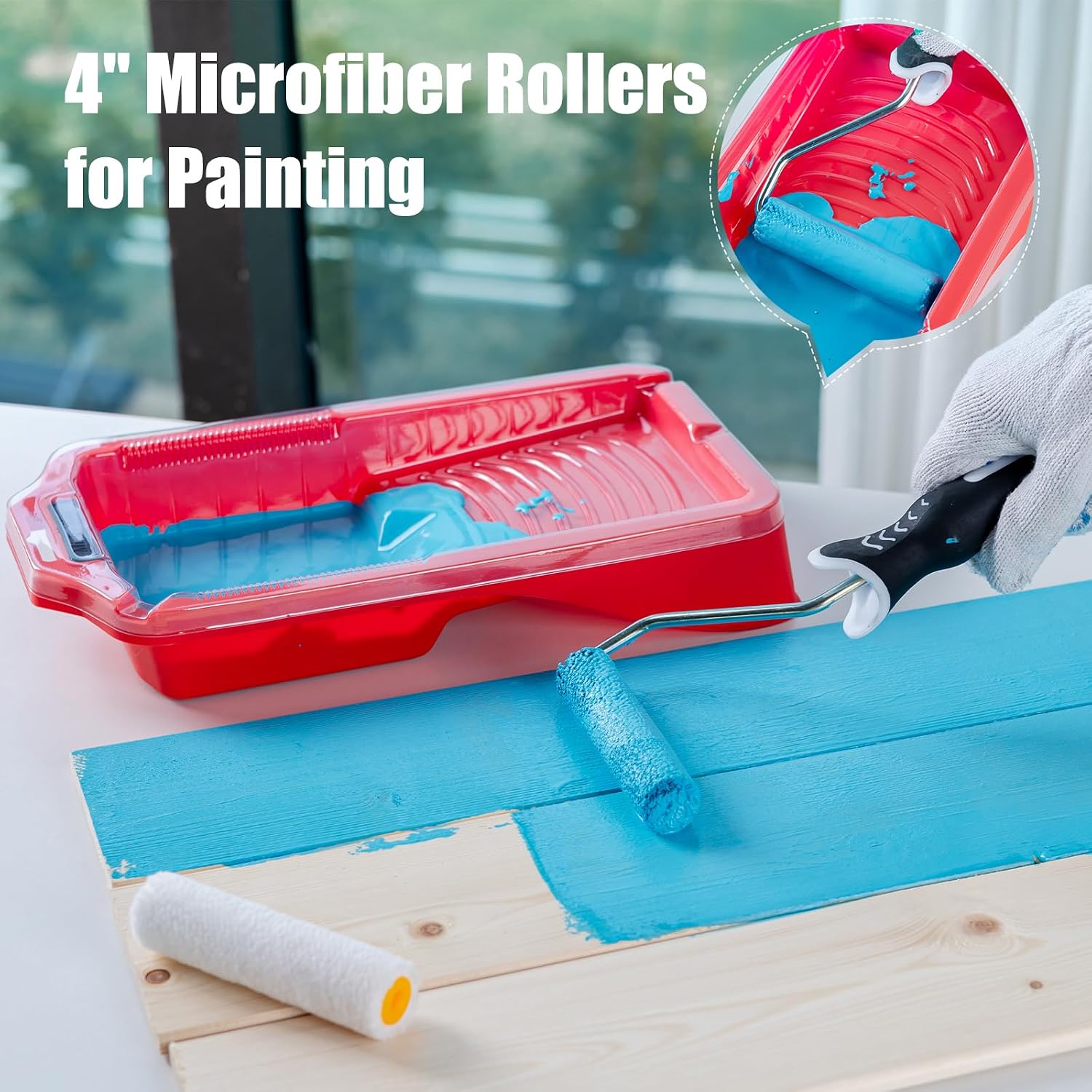
You’re standing in the paint aisle with a gallon of Benjamin Moore Advance (a water-based alkyd — meaning it brushes like latex but self-levels like oil paint, with very little visible brushstroke when it dries) and suddenly realize you have no idea what to apply it with. A standard 9-inch roller — the big cylinder you’d use to paint a bedroom wall — is comically oversized for a cabinet door. A brush will work, but it leaves fine lines in the finish. That’s the gap a mini roller fills: a 4-inch or 6-inch roller frame with a short, dense foam or microfiber cover that lays paint onto flat and semi-flat surfaces with almost no texture. For cabinet repaints, furniture makeovers, and trim work, a good mini roller kit is genuinely the difference between a finish that looks professional and one that looks like a weekend project gone sideways. This guide breaks down what to look for, which kits are worth the money, and exactly when to reach for a foam cover versus a microfiber one.
What “Nap” Means and Why It Decides Everything
The nap (also called the pile) is the thickness of the roller cover — how deep the fibers or foam extends from the core. On a standard wall roller, nap ranges from 3/8-inch (for smooth drywall) up to 3/4-inch or more (for stucco or brick). On mini rollers for cabinets and furniture, you’re almost always working in a tighter range:
- Foam covers (no measurable nap): The flattest possible finish. Almost zero stipple texture. Best for high-gloss or semi-gloss paints on genuinely smooth surfaces like MDF cabinet doors or lacquered furniture. The tradeoff: foam holds less paint per pass, so you’re reloading frequently, and it can introduce bubbles if you roll too fast.
- 1/4-inch microfiber or short-nap covers: A slight texture, but far less than a wall roller. These hold more paint, work better on surfaces with any grain or slight imperfection, and are more forgiving with thicker paints. Per This Old House’s guide to painting kitchen cabinets, a short-nap woven cover on flat cabinet faces tends to outperform foam when the paint itself has a longer open time (meaning it stays wet longer, allowing the texture to flatten out before drying).
- 3/8-inch covers: Rarely the right call for cabinets or furniture. More appropriate for lightly textured trim in older homes. If you’re buying a kit and it only includes a 3/8-inch cover, the kit is probably designed for baseboards on textured walls — not for the kind of furniture-grade finish most repaint projects are chasing.
The Spruce’s roundup of mini paint rollers specifically flags this nap mismatch as the most common mistake practitioners make when buying a kit off the shelf: the cover included in a budget combo kit is often a 3/8-inch general-purpose cover, not the foam or 1/4-inch short-nap that cabinets actually need.
By the Numbers: Mini Roller Specs at a Glance
| Cover type | Nap depth | Best surface | Typical finish | Reload frequency |
|---|---|---|---|---|
| Foam | 0–1/16 in. | Smooth MDF, laminate | High-gloss, mirror-smooth | High (less paint held) |
| Microfiber 1/4 in. | 1/4 in. | Wood grain, slight imperfection | Semi-gloss, satin | Medium |
| Woven short-nap | 3/8 in. | Lightly textured trim | Satin, eggshell | Low |
Roller width also matters: 4-inch covers are the right size for most cabinet door rails (the narrow horizontal and vertical frames around a door panel) and furniture drawer fronts. 6-inch covers are better for wide flat panels — a full cabinet door face, a tabletop, a dresser drawer bank.
Frame Quality: The Part Nobody Talks About
Most practitioners focus entirely on the cover and ignore the frame, which is the metal or plastic cage that holds the cover and connects to the handle. This is a mistake.
A cheap frame wobbles. When the cover shifts sideways mid-stroke, you get an uneven paint deposit — a thick edge on one side of your stroke and a thin one on the other. On a wall, that’s invisible after two coats. On a cabinet door in a semi-gloss finish, it shows.
What to look for in a frame:
- Solid end caps that hold the cover firmly without allowing lateral movement. Owners across multiple Bob Vila review aggregations consistently cite wobbly end caps as the primary failure mode on budget mini roller kits.
- A threaded or secure handle connection. Frames with a wobbly handle connection transfer that wobble directly into your stroke pressure, making consistent coverage nearly impossible on small flat panels.
- Cage wire gauge. Thicker wire = less flex under pressure. This matters more than it sounds when you’re pressing into a corner or rolling close to a cabinet frame edge.
Wooster and Purdy both manufacture mini roller frames that reviewers at The Spruce and Bob Vila consistently point to as the durability standard. Both brands are available at most paint specialty retailers and big-box stores. Whichever frame you choose, buy it separately from the cover if possible — the covers that ship in combo kits are often not the cover you actually want for a specific paint and surface combination.
Matching the Kit to the Paint: The Pairing That Actually Drives Results
The cover choice isn’t just about the surface — it’s about the paint’s viscosity (thickness) and how it levels (how well the wet film flattens out before drying).
Water-based alkyds (Benjamin Moore Advance, Sherwin-Williams Emerald Urethane Trim): These are among the most popular choices for cabinet repaints right now because they combine water cleanup with the hard, smooth finish traditionally associated with oil paint. They have a longer open time — meaning they stay wet long enough for the roller stipple to relax and flatten. Apartment Therapy’s guide to brush-mark-free cabinet finishes specifically recommends a 1/4-inch microfiber cover with water-based alkyds because the extra paint-holding capacity of microfiber supports the self-leveling process better than foam, which deposits too thin a film per pass.
True latex paints (Sherwin-Williams Emerald Interior, Benjamin Moore Aura): These dry faster and are less forgiving of thin application. Foam covers work here if your surface is genuinely flat and smooth. If there’s any grain, go microfiber.
Chalk-style and mineral paints (Portola Rooms limewash, Annie Sloan Chalk Paint): These are thick, matte, and intentionally texture-forward. Mini rollers are rarely the right tool here — the finish is supposed to show some irregularity, and a brush or even a chip brush gives more control. If you’re using a mini roller on chalk paint for speed, a 3/8-inch woven cover at minimum; foam will drag and tear.
Fine Paints of Europe Hollandlac and similar European oil-based finishes: These are brush-applied by design. The self-leveling chemistry is tuned for bristle application, and most experienced finishers working with these products report that roller application introduces micro-bubbles that don’t fully release before the film skins over. Stick to the badger-hair or ox-hair brushes Fine Paints of Europe recommends in their application documentation.
The Foam vs. Microfiber Decision Rule
After synthesizing owner reports across multiple review sources — including The Spruce’s mini roller roundup and aggregated retailer reviews — the pattern is consistent enough to state as a rule:
If your surface passes the fingernail test (absolutely no detectable grain or texture), and your paint is a water-based alkyd or premium latex in semi-gloss or higher, start with foam. You’ll get the flattest possible finish and the tightest stipple release. Reload often, keep your strokes light, and don’t roll over partially dried sections.
If there’s any surface variation, any wood grain telegraphing through primer, or if you’re using a satin sheen or lower, go 1/4-inch microfiber. The slight additional texture from microfiber is invisible under satin and eggshell, and the better paint-holding capacity means more consistent film thickness across the panel — which is what actually drives a smooth final result.
If you’re painting textured or routed trim profiles — think raised-panel cabinet doors with routed edges, or decorative furniture molding — the mini roller handles the flat field and a small angled sash brush handles the crevices. No roller cover works well in a routed groove. This is a two-tool job.
Kit Recommendations: How to Shop This Category
There is no single mini roller kit that wins every scenario, but here’s how to evaluate what’s on the shelf or what you’re comparing online:
Budget entry ($8–$15 for frame + covers): Shur-Line and Wooster both make serviceable entry kits. The covers in these kits are generally adequate for one or two cabinet doors, but they start to shed fibers after the first wash — which means you’re buying covers individually after the first project anyway. Treat these as a starter pack, not a long-term supply strategy.
Mid-range working kit ($20–$40 for frame + multiple covers): Purdy and Wooster both offer kits in this range with higher-density covers that hold up through multiple washes and reuses. Owners in long-run reviews consistently note that a Purdy or Wooster frame outlasts three or four budget frames in a professional painting context. The math here favors the mid-range option if you’re doing more than one project.
Premium cover restocking ($5–$12 per cover): Once you have a quality frame, buy covers by type rather than by kit. Stock a few foam covers for gloss work, a few 1/4-inch microfiber covers for satin and semi-gloss, and you’re set for most cabinet and furniture scenarios.
Intent marker — mini roller kits, mid-range:
Intent marker — foam roller covers 4-inch, multipack:
Intent marker — Purdy or Wooster mini roller frame:
The Clear “If X, Then Y” Summary
- If you’re painting smooth MDF cabinet doors with Benjamin Moore Advance or Sherwin-Williams Emerald Urethane in semi-gloss, then use a 4-inch foam cover on a Wooster or Purdy frame. Reload often, keep pressure light.
- If you’re painting wood-grain cabinet boxes or furniture with any satin finish, then use a 1/4-inch microfiber cover. The slight texture disappears under satin; the better paint load gives you consistent coverage.
- If you’re painting decorative trim with routed profiles, then use a mini roller for the flat field only and finish the grooves with a 1.5-inch angled sash brush. Don’t fight the geometry.
- If you’re buying for a one-time project, then a budget kit frame with mid-range covers is the right call. If you’re buying for repeat work, then invest once in a Purdy or Wooster frame and stock covers by type.
The mini roller category is not where most paint projects fail — but it is where a lot of otherwise careful projects introduce unnecessary texture or uneven coverage right at the end. Get the nap right, match it to your paint, and the finish takes care of itself.