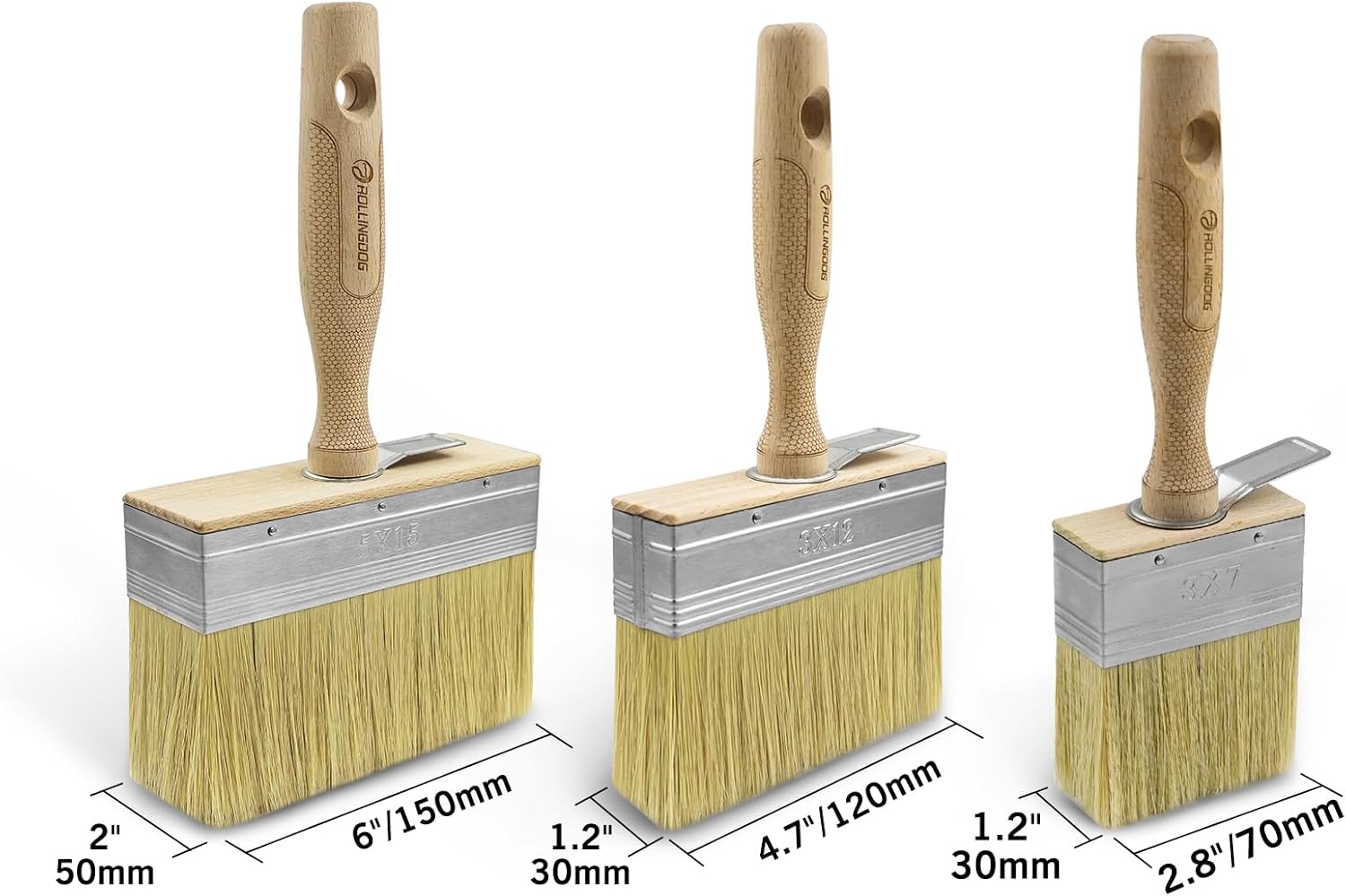
You’re standing in the paint aisle with a gallon of deck stain in one hand and no clear plan for how to actually put it on the wood. The store sells everything from a $1.29 disposable “chip brush” — a flat, natural-bristle brush that looks almost too simple to be useful — to a $28 deck staining pad on an extension pole. A chip brush is exactly what it sounds like: a cheap, expendable brush, originally designed for applying adhesives and resins, that painters have borrowed for decades because it’s stiff, fast, and costs nothing to throw away. The deck pad is a foam-and-fabric applicator that lays stain onto flat surfaces quickly but struggles in the gaps between boards. Neither tool is universally right. The one you pick determines how long the job takes, how much stain you waste, and whether you’re on your knees for three hours. This guide maps the tradeoffs clearly so you can match tool to project before you’re already on the deck.
What You’re Actually Choosing Between
The exterior applicator market breaks into four categories that matter for real jobs:
Chip brushes (natural bristle, 1”–4” wide, $0.79–$3.00 each). Stiff, dense bristles with no ferrule quality to speak of. They shed bristles into your stain, they don’t hold a clean edge, and they wear out fast. None of that matters if you’re using them the right way: flooding stain into end grain, working penetrating oil stains into rough-sawn wood, or getting into the cracks between deck boards where nothing else reaches. This Old House’s deck stain application guide specifically recommends a natural-bristle brush for working stain into board gaps and end grain before a wider applicator covers the flat faces — using the cheap brush where precision and penetration matter, not where coverage speed does.
Synthetic polyester/nylon brushes (2”–4”, $8–$22). These are standard interior-grade brushes pressed into exterior use. They hold more product, release it more evenly, and don’t shed like chip brushes do. For fence painting with a solid-color exterior latex, a good 3” or 4” synthetic brush from Purdy or Wooster is a legitimate choice. But they’re slow on large flat areas, and they’re more expensive to replace when stain loads them up and they stiffen overnight.
Foam roller applicators and deck pads ($12–$30). Foam rollers cover flat surfaces fast — a 9” foam roller on a standard frame can do the face of 12 deck boards in the time it takes a brush to do three. The tradeoff is that foam traps air and creates bubbles in thick stains, and it completely fails between boards and on rough-sawn wood with open grain. Deck pad applicators (a flat foam-and-fabric pad on an articulating head, often sold by brands like Shur-Line) solve the bubble problem somewhat because they don’t roll — they drag — but they still skip gaps. Bob Vila’s roundup of deck stain applicators ranks pad applicators highly for smooth composite decking but flags them as inadequate for pressure-treated pine with board gaps over ¼ inch.
Pump sprayers and airless sprayers ($20–$450+). Out of scope for this guide’s core audience — sprayers introduce overspray, masking complexity, and cleanup overhead that changes the job’s economics entirely. The Architectural Digest exterior prep guide notes that sprayer application on decks almost always requires back-brushing anyway, which means you still need a brush in the workflow.
The Price-to-Performance Math
Here’s where the tradeoffs become concrete. Let’s use a real scenario: a 400-square-foot pressure-treated pine deck, two coats of penetrating oil-based stain (Defy Extreme or TWP 1500 Series), with gaps between boards averaging 3/16”.
By the numbers:
- Chip brush (3”, 6-pack): ~$7–$9 total. Use one brush per coat per day; bristle shedding is manageable at this pace.
- Purdy Nylox 3” synthetic brush: $14–$18 each. Washable, reusable, better release — but oil-based stain cleanup is solvent-intensive; most owners report replacing them after 2–3 uses anyway.
- Shur-Line deck pad applicator: $18–$24. Covers flat faces 3× faster than a brush, but owners consistently report needing a chip brush alongside it to chase gaps and edges.
- Foam 9” roller + frame: $8–$12. Fast on faces, but aggregated reviewer reports across multiple retail platforms show a high rate of bubble complaints with oil-based stains specifically.
The cost-per-use math favors a hybrid approach: one 6-pack of chip brushes ($8) plus one deck pad applicator ($22) runs about $30 total — and covers both the precision work (gaps, end grain, perimeter boards) and the fast flat-field work. Compared to using only a quality synthetic brush at $16 each, you finish faster and use less stain because the pad doesn’t over-load rough wood the way a brush does.
Where this math changes: smooth composite decking. On Trex or TimberTech, there are no gaps to chase and no open grain to load. A foam roller or deck pad alone handles the job cleanly, chip brushes are unnecessary, and the $16 synthetic brush is actually the right single-tool pick for cut-in work around the perimeter.
Fence Painting: A Different Calculus
Deck staining and fence painting look similar but behave differently as applicator problems. Fences are vertical (gravity works against you), usually have more linear footage than surface area, and are often painted with solid-color latex rather than penetrating stain — which means you need a brush that holds a wet edge.
The Spruce’s chip brush buying guide makes a clear distinction: chip brushes are appropriate for stains and adhesives that want to be worked in, but they’re a poor choice for solid-color paints that need even film build. On a fence, uneven film build shows as lap marks. A cheap chip brush will get paint on a fence, but owners consistently report visible stroke marks and lap lines when using them with solid latex.
For solid-color fence painting, the decision tree looks like this:
If your fence has flat boards (privacy fence, shadowbox): A 4” wide synthetic brush like the Wooster Shortcut or Purdy XL series gives you the combination of speed and edge control you need. At $18–$24 each, they’re worth the investment when you’re covering 200+ linear feet. The Architectural Digest exterior guide recommends a wide synthetic brush specifically for solid-color applications on vertical wood surfaces.
If your fence is picket-style with lots of narrow vertical members: A 2” angle sash brush is faster than a wide brush here because you’re wrapping around thin surfaces rather than covering broad faces. Owners who’ve done both consistently report that the wider brush wastes more time loading and repositioning than it saves on coverage.
If your fence is rail-and-post with rough-sawn cedar or treated pine: This is the one place a chip brush earns its keep on a fence project — use it to work stain or solid color into the open grain before a second pass with a quality brush. Think of it as the first pass tool, not the finish tool.
When to Splurge and When to Buy the $1 Brush
Let’s be direct about where the premium brush tier actually earns its price on exterior work.
The splurge is justified when: You’re applying a premium transparent or semi-transparent deck stain — Armstrong Clark, TWP 1500, Defy Extreme — where the quality of penetration determines whether the stain lasts 2 years or 4. A quality natural-bristle brush (real China bristle, not the loose-fiber chip brush construction) holds more product and releases it more consistently into the wood. Published specs from manufacturers like Armstrong Clark recommend natural-bristle brush application specifically for maximum penetration — and that means spending $12–$18 on a Purdy or Corona natural-bristle brush, not the hardware-store chip brush.
The $1 chip brush wins when: You’re doing the detail pass — end grain on cut boards, the first saturating coat on cracked or weathered wood, getting stain into gaps and knots before the main applicator covers the field. Here, you want something you can press hard with, work back and forth, and throw away. Spending $18 on a brush you’re going to destroy in the first pass is the wrong call.
The middle tier is often the real value: The $18–$24 deck pad applicator is the most underrated tool in this category for anyone doing a full deck re-stain every 2–3 years. Owners report cutting their application time by 40–50% on large flat decks versus a brush alone. That time savings translates directly — a day job that runs three hours instead of six is a different project.
The Decision Rule
Here’s the practical framework for most exterior projects in 2026:
If you’re staining a natural wood deck (pine, cedar, redwood) with a penetrating oil-based stain: Buy a 6-pack of chip brushes ($8) for gap and end-grain work, plus a deck pad applicator ($20–$24) for the field. Total outlay: ~$30. This is the fastest, most thorough combination for the most common deck stain job.
If you’re painting a fence or deck with solid-color latex: Skip chip brushes entirely. Buy a 4” Wooster or Purdy synthetic brush ($18–$22) and work in sections to maintain a wet edge. Budget for two brushes on large projects if you’re working on separate days.
If you’re staining composite decking: One deck pad or foam roller handles the job. Add a 2” synthetic sash brush for perimeter cut-in. No chip brushes needed.
If you’re doing both a deck and a fence in the same weekend: The chip brush 6-pack, one deck pad, and one 4” synthetic brush is a $50 total kit that covers every scenario without redundancy. That’s the kit worth buying.
The $1 chip brush is not a compromise — it’s the right tool for specific tasks that an $18 brush handles worse. Knowing which task is which is what separates a fast, clean exterior project from one that takes twice as long and looks half as good.