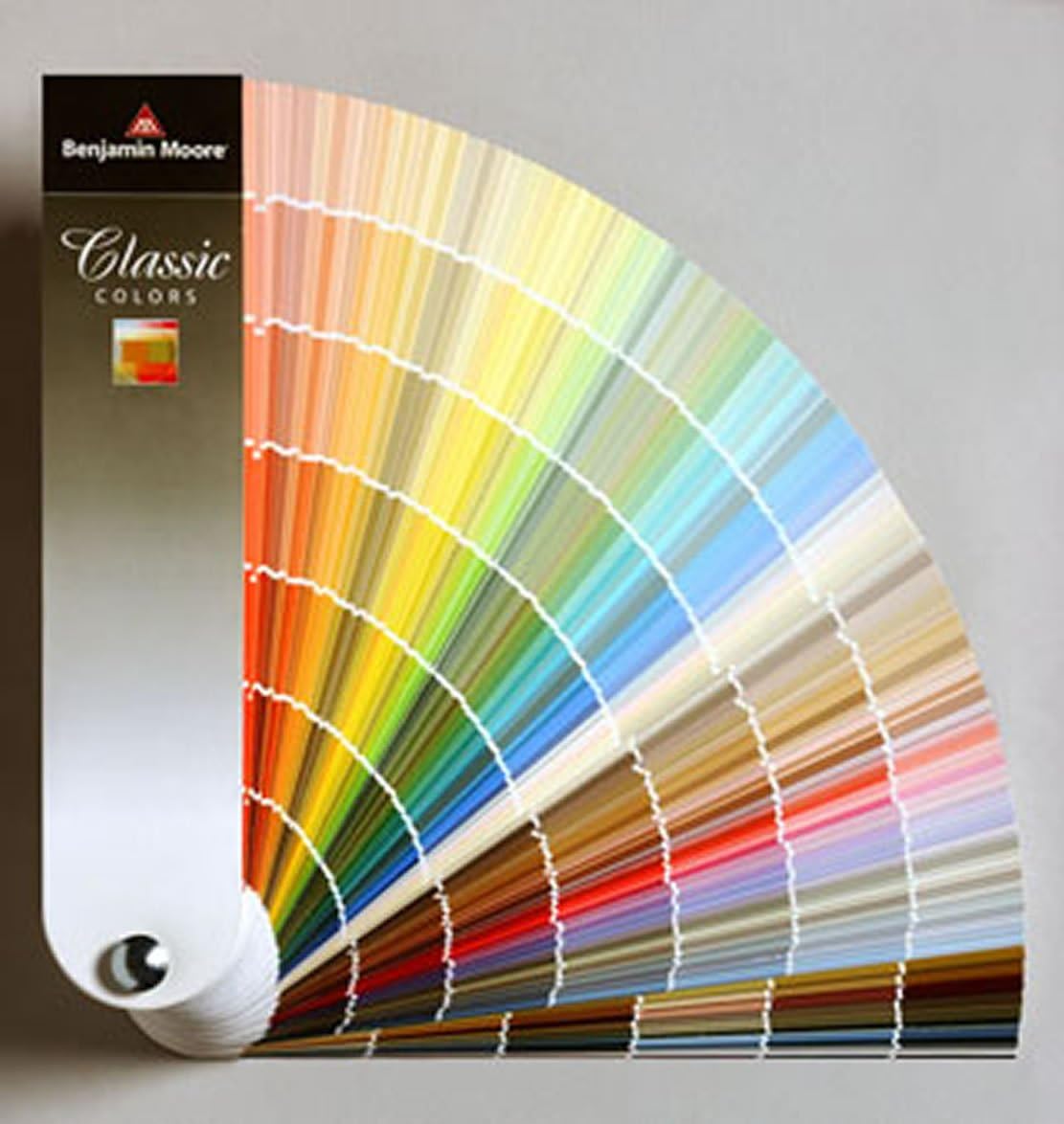
You’re standing in a Benjamin Moore dealer, staring at a wall of individual paint chips — little 2×6-inch paper rectangles, each with five shades stacked vertically. You grab a handful, take them home, tape them to the wall, and immediately realize three of them look nothing like they did in the store. This is not a you problem. It’s a lighting problem, a context problem, and honestly, a tool problem. The individual chip is the wrong instrument for serious color work. The tool designers actually reach for is the fan deck — a spiral-bound or hinged booklet containing hundreds of color swatches organized so you can flip, compare, and shortlist without taping anything to a wall.
A fan deck doesn’t replace paint samples (more on that later), but it’s the fastest way to move from “I like something in the blue-green family” to a shortlist of three real contenders. If you’re specifying paint for a client, managing multiple rooms, or just tired of the chip-shuffle, understanding how fan decks work — and which Benjamin Moore deck to own — will meaningfully speed up your process.
What’s Actually Inside a Benjamin Moore Fan Deck
Benjamin Moore produces several fan deck formats, and the differences matter depending on your workflow.
The Classic Color Collection Fan Deck is the flagship. It contains Benjamin Moore’s full portfolio of 3,500+ colors, organized by hue family, with each color shown as a chip roughly 1.5×2 inches. Colors are arranged in tonal strips — so you’ll see a warm cream, its slightly grayer cousin, and a deeper version of the same hue all on the same page. That grouping is intentional. When designers say fan decks make color relationships visible, this is what they mean: you’re not choosing a single color in isolation, you’re seeing how it sits within a family.
The Historical Colors Fan Deck is a curated subset of 175 shades drawn from pre-20th-century American interiors — muted, complex, and often more forgiving in mixed-light situations. Interior designers working on restoration projects or period-appropriate renovations frequently carry both the full Classic deck and this one. The Spruce’s coverage of Benjamin Moore color collections notes that the Historical palette is a go-to for practitioners who want depth and age without going full Farrow & Ball on the budget.
The Affinity Collection Fan Deck is Benjamin Moore’s pre-curated harmony system: 144 colors selected specifically because they work together. Each group of 16 shares an undertone, which means pulling three colors from the same Affinity group is a near-guaranteed way to achieve a cohesive whole-home palette. This is the deck interior designers hand to clients who want autonomy without risk — “pick anything from this group and it will coordinate.”
The Off-White Collections Deck is exactly what it sounds like: a dedicated look at Benjamin Moore’s white and off-white range, which is extensive enough to warrant its own format. Whites behave more dramatically than any other color under shifting light, and this deck lets you compare subtle pink, yellow, and green undertones side by side in a way that individual chips simply cannot.
The Matching Gap: Why Digital Tools Don’t Replace Physical Decks
By the mid-2020s, every major paint brand has an online color visualizer. Benjamin Moore’s Color Portfolio app lets you upload a room photo and digitally “paint” the walls. It’s useful for ruling out obvious mismatches — you can quickly see that the deep navy you’re considering will make a small bedroom feel like a closet. But designers and color-forward homeowners consistently report that visualizers fail at the job fan decks do best: showing you the actual pigment relationship between two colors you’re considering pairing.
Apartment Therapy’s coverage of paint swatch accuracy makes a point worth internalizing: screens render color in RGB (red-green-blue light), while paint reflects light from pigment. The same color looks different on a calibrated studio monitor versus an iPhone versus a laptop with a warm color profile. A physical fan deck, by contrast, shows you the dried pigment — or close enough to it — under the light that’s already in your hand.
This doesn’t mean digital tools are useless. The workflow most designers describe, per Architectural Digest’s reporting on how professionals select paint colors, goes like this:
- Use the online visualizer or app to eliminate obvious misses and narrow from “hundreds” to “a dozen or so.”
- Use the fan deck to understand how those candidates relate to each other and to rule out near-misses that look similar on screen but read differently in person.
- Order full-size peel-and-stick samples or quart samples to test on the actual wall.
The fan deck lives at step two. It’s not the finish line — it’s the shortlisting instrument.
How to Actually Use a Fan Deck (Not Just Own One)
Owning a fan deck and using it well are different things. Here’s how practitioners get the most out of them.
Take it to the room, not the other way around. The single most common mistake is color-matching under store or kitchen fluorescents and then being surprised when the color reads differently in a north-facing bedroom. Fan decks are portable for a reason. Evaluate your shortlist candidates in the room they’ll live in, at the time of day the room gets the most use.
Work the undertone, not the hue name. Benjamin Moore’s naming conventions (“Pale Oak,” “Simply White,” “Quiet Moments”) are marketing, not specification. What matters is the undertone — the secondary color that surfaces as light shifts. This Old House’s guide to reading paint chips recommends looking at a chip’s darkest shade (the bottom of the strip on most Benjamin Moore chips) to identify the undertone, since it becomes more visible as the color deepens. If the darkest shade goes green, the lightest shade has a green undertone whether you can see it or not. Fan decks make undertone comparison fast because the chips are large enough and adjacent enough to compare under identical lighting.
Use the fan to cross-reference trims and ceilings. A wall color that looks perfect in isolation can fight with the trim if their undertones conflict. Fan deck workflow: hold your wall candidate next to your trim candidate. If both are in the Benjamin Moore family, you’ll find them quickly; if your trim is a different brand, bring that chip to the dealer and ask them to point you to the nearest match in the fan.
Photograph the page, not the chip. When you’re building a presentation for a client or documenting a color palette for a multi-room project, photographing the fan deck page gives you context that a single chip photo loses. You can see the color family, the adjacent shades, and the chip number all in one frame.
By the Numbers
| Fan Deck Format | Color Count | Best For | Typical Dealer Price |
|---|---|---|---|
| Classic Color Collection | 3,500+ | Full-project spec, all-purpose | $15–$25 |
| Affinity Collection | 144 | Whole-home harmony, client handoff | $8–$15 |
| Historical Colors | 175 | Restoration, period interiors | $8–$15 |
| Off-White Collections | ~50 | White/trim selection | $5–$10 |
Prices are dealer-sold and not standardized nationally; some Benjamin Moore dealers provide fan decks free to trade accounts. As of mid-2026, the full Classic deck remains the best single purchase for anyone specifying more than one room.
The Sample Step You Can’t Skip
Fan decks narrow the field. They do not close it. Elle Decor’s reporting on why designers still rely on physical swatches consistently emphasizes one thing: a fan deck chip is roughly 6–8 square inches of coated paper under uncontrolled lighting. It is not a dried latex or alkyd film on your specific wall substrate, under your specific lighting, next to your specific flooring.
The final step before committing to a gallon is always a large-scale sample. Benjamin Moore’s peel-and-stick Color Samples (approximately 8×8 inches of actual painted film) and their quart-sized “Gennex” sample jars both allow you to put real paint on a real wall. The fan deck shortlists to three candidates; the sample tells you which one to buy.
For high-stakes specifications — an Aura or Regal Select whole-home project at $70–$85/gallon, or a premium architectural finish order pushing into four figures — skipping the sample step to save $10–$15 is a genuinely expensive mistake. A single gallon of Benjamin Moore Aura represents roughly $85; a quart sample at $8–$12 is the cheapest insurance in a design project.
If X, Then Y: The Decision Rule
Here’s the plain version of what all of this adds up to:
If you’re specifying a single room and already have a rough direction, start with the Classic fan deck, shortlist to three colors, buy peel-and-stick samples, and decide.
If you’re doing a whole-home project and want a coordinated palette without spending hours on color theory, get the Affinity Collection fan deck. Pick a group of 16 that feels right and stay inside it. The coordination math is already done.
If you’re a designer managing multiple clients or projects, own both the Classic deck and the Affinity deck. The Classic is for full-range searching; the Affinity is for client handoff. Some dealers will comp you the Affinity deck if you have a trade account.
If your project involves period details, historic trim colors, or a client who keeps referencing “old-house colors”, add the Historical Colors deck. It’s narrow enough to flip through in five minutes and focused enough to save you an hour of searching the full Classic range.
If you’re agonizing over white trim, the Off-White deck is worth its modest price just to see the undertone spread side by side. Five near-identical whites that look the same on a screen will reveal themselves very clearly under the light in your actual room.
The fan deck isn’t glamorous. It’s a spiral-bound booklet that probably lives in a bag with a tape measure and a Sharpie. But it’s the tool that closes the gap between “I think I want something like this” and a confident paint order — and for a $15–$25 investment on a project where a single color mistake can cost hundreds in repaint labor, it’s the most straightforward value in the workflow.